

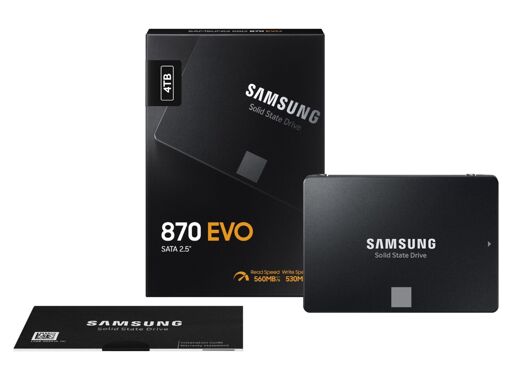
Samsung is reportedly preparing to wind down its SATA SSD business, and a notable hardware leaker warns the move could have broader implications for consumer storage pricing than Micron’s decision to end its Crucial RAM lineup. The report suggests reduced supply and short-term price pressure may follow as the market adjusts.
For a second I thought Samsung was ending production of all consumer SSDs, including NVMe.
SATA SSDs are IMO a niche use case. If you don’t have any free M.2 slots, you can always get a PCIe adapter card and deploy multiple NVMe drives.
There are still a lot of devices in use that don’t support NVMe, especially older portable devices. And there are plenty of boards with M.2 slots that only support SATA, not NVMe, over some or all of those slots. It’s one of the areas that board manufacturers often use to cut corners and reduce costs.
Getting a separate PCIe card is easy enough for a desktop, even a low profile one, but that’s not an option across the board.
That being said, SATA SSD production was already probably getting near being dramatically reduced because NVMe is so prevalent now.
Adding a second NVMe drive may not be hard, but adding a couple dozen more for a NAS means forking over a lot of money for a high end CPU with an extra 96 PCIe lanes. That high end CPU also means high power consumption. For SATA or SAS, you only need a single slot with 8-16 lanes for the controller card.
Most small scale home and business NAS deployments are still going to use spinning disks, not SSD due to the lower cost per GB and the fact that HDD arrays already have enough speed for most small scale use cases.
My disk array at home gets close to SATA SSD speeds in most workloads already, and it’s plenty fast enough for anything I can throw at it.
SATA SSDs are the standard de facto, default variant. All other is “niche”.
Not really. SATA SSDs make little sense compared to alternatives because SATA isn’t fast enough to saturate the drives’ throughout. SATA’s strength from my point of view comes in when you want to attach lots of storage for cheap, but that’s better served with HDDs. Sure, there are cases where you might want the fast access times of SSDs but don’t need its bandwidth, and SATA is me ubiquitous than other connectors, but that’s an edge case that seems to be no longer economically viable for Samsung.
Btw, casings that convert M.2 to SATA 3 exist for cheap.
I built my PC with m.2 back in 2019, hasn’t SATA been moved on?
yeah 80% of market is not SATA
And DIY components is a relatively small segment of the market compared to laptops and pre-builts. I wouldn’t be surprised if it’s in the 10-15% range of total revenues even for companies like AMD that have strong market momentum in the space.